DIN 10524 - Workwear in groceries companies
In all places, where groceries are processed, working clothes should not only be used for the identification of the employer or to guarantee a unique appearance of the workforce, but especially to protect groceries against negative influences. Beyond it the user of modern working clothes should feel comfortable to guarantee his permanent efficiency. Since May 2004 hygienic standards for working clothes in the food industry as well as standards for wearing comfort are bindingly defined with Norm DIN 10524 “Working Clothes in the Food Industry”. According to a hygienic risk scale for different functions within a company three risk classes with different standards are defined.
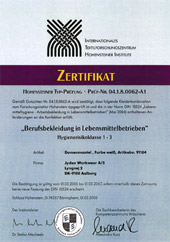 The Hohensteiner Institutes in Bönningheim inspect working clothes which should be used in food companies. During their inspections they investigate if the combination of different clothes, e.g. trousers and smock overall, is in line with the standards defined with DIN 10524. The conformance with the standard for the upper material and the ready-made clothing is tested separately. If the textile fulfils the requirements under the standard, it will be documented with a conformance certificate either for the upper material or the ready-made clothing. The conformance certificate will be issued, depending on the nature of the clothing combination, for a single or for all three risk classes and will support the consumer to make his choice for appropriate and DIN-conform working clothes, matching the requirements of different working areas of a food company.
Risk Classes:
| Risk Class 1 = Low Hygienic:
If the hygienic risk is considered low (contact with non perishable food or ingredients), the protection capacity of the working clothes against the food can be low, if the food is adequate protected by the packaging or if it is going to be processed by the manufacturer or consumer. |
| Risk Class 2 = High Hygienic Risk:
If the hygienic risk is considered high (contact with non packaged perishable food or ingredients), the protection capacity of the working clothes needs to be high, especially if the food is not going to be further processed and micro organisms are likely to spawn (e.g. transfer of non packaged food). If the food is technical processed and by the means of this process a purposeful influence of the original germinitive flora is effected (e.g. heating, to salt, chemical conservation or drying), the practice is also considered to be of high risk. |
Risk Class 3 = Highest Hygienic Risk: If the hygienic risk is considered highest (contact with non packaged ready to eat, easily perishable food), a very high protection capacity of the working clothes must be ensured because the food is not stabilized by technologic process and micro organisms, including pathogenic germ, are likely to spawn. |
All of the HACCP collection is certified for all risk classes and available in Intex sizes from stock. The collection also fulfils the requirements of pharmaceutical areas (not for clean rooms).
We would be pleased to supply you with your new HACCP clothes in the future. By request we also provide you with the certificates issued by Hohensteiner Institutes.
Quelle: Hohensteiner Report Nr. 61, Hohensteiner Institute in Bönnigheim